Aftershock for Quake
Loading up Aftershock for Quake drops you right back into the brown, oppressive corridors of id Software's classic engine, though this time through a commercial batch of level design packaged by Head Games Publishing, Inc.
Stepping into E1M1 and the shovelware aesthetic
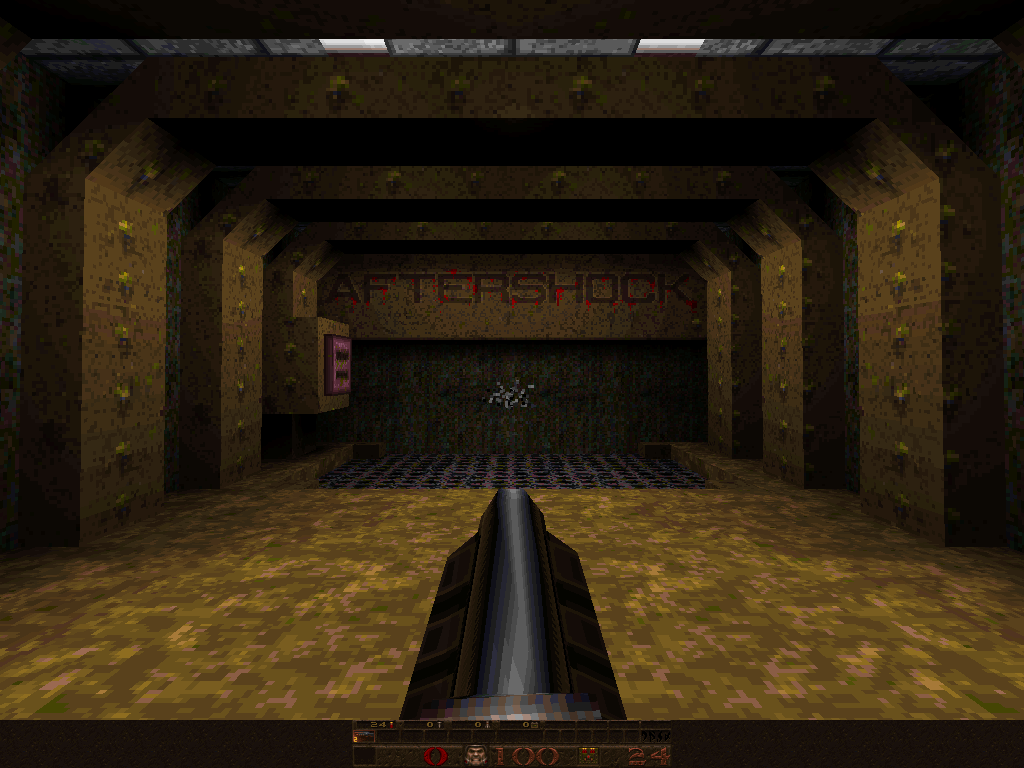
The moment you launch E1M1: "House of Desolation", the familiar thud of your nailgun echoing down grey stone corridors lets you know what you are in for. There are no new weapon models, no custom enemy sprites, and no new sound effects on this disc. You drop into familiar slipgates, hunt down gold keys, and sidestep Ogres chucking grenades with the exact same physics you memorized in original Quake.
What sets this collection apart from official expansions is its pacing. Where id Software built long, sprawling layouts that built tension before dumping three Fiends into a dark room, levels like E1M2: "Darmack" move fast and end quickly. You clear out a courtyard of Grunts, grab a Super Shotgun, solve a quick switch puzzle, and touch the exit teleport before your armor even takes a severe beating.
That speed run feeling is everywhere across the single-player content. The three custom episodes offer five maps apiece, but almost every level feels condensed. You get the 1996 Head Games Publishing, Inc. experience: map pack design that wants to pull you through rapid arenas rather than let you wander through massive gothic architecture.
How Aftershock for Quake reshuffles vanilla monsters and weapons
Because the pack relies entirely on standard engine graphics and assets, every encounter relies on map geometry to create difficulty. A room with two Shamblers hits hard not because the monsters behave differently, but because the floor space is half what you would get in an official episode. In maps like E3M1: "The Surface", outdoor low-gravity layouts push you into mid-air skirmishes where a missed rocket means falling into void space.
The weapons carry the exact heavy impact you expect from an add-on game running on MS-DOS. Picking up the Thunderbolt and clearing out a drowned basement full of Scrags feels great, but the lack of custom art assets means you never stumble onto a surprising visual treat. It is pure, unadulterated stock content thrown into fresh maze configurations.
For multiplayer fans, the disc included a massive set of deathmatch maps designed specifically for rapid fragging. These arenas trim away all the single-player puzzle elements, placing Rocket Launchers and Quad Damage powerups right in central crossfire zones to force immediate action.
The THRED editor, cheat sheets, and commercial level packs
In 1996, buying an unofficial pack at retail was less about expecting polished narrative campaigns and more about getting tools and map troves on a single compact disc. Head Games Publishing, Inc. bundled the CD with THRED, a popular 3D level editor, along with text files covering complete lists of console cheats and map tricks for the base game.
French gaming magazine Joystick highlighted the disc in late 1996, covering it alongside the exploding retail market for user-made FPS expansions. The success of this disc led directly to follow-up commercial releases, including the Aftershock Toolbox and Aftershock Deathmatch 300 map compilations, which refined the same formula for multiplayer nuts.
Short episodes, German bans, and 16-bit installer headaches
Retrospective critics often poke fun at the set for having short episodes and a punny title, but it earned real attention from ratings boards at the time. Due to strict regulations surrounding 3D violent shooters, Germany's BPJM official agency indexed the retail package in July 1997, restricting its sale across German territory.
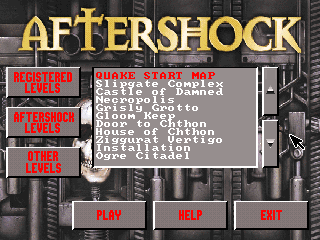
If you try running the original disc on a modern setup today, you will hit an immediate brick wall. The original physical release shipped with a 16-bit installation program that simply refuses to launch on modern 64-bit operating systems, forcing players to manually pull map files out of custom directory folders.
Yet for anyone looking to taste how custom map design felt during the first months of 3D gaming, this set provides an authentic snapshot. It captures the exact transition point where bedroom level authors were figuring out brush geometry, lighting values, and trigger zones in real time.
Play Aftershock for Quake online right now
You do not need to hunt down a physical disc or fight with broken installers to experience this 1996 MS-DOS game today. You can play Aftershock for Quake free in your browser right here, fully configured and ready to run inside an emulation layer.
When you start, head straight into E1M1: "House of Desolation". Within the first sixty seconds, you will dodge past shotgun-toting soldiers, grab a red key, and jump into quick circle-strafe combat that proves how fast mid-nineties level design moved. If you want to play Aftershock for Quake online without any hassle, hit the prompt below and start blasting through these custom maps immediately.