Jazz Jackrabbit: Holiday Hare 1995
Checking…
Before full game expansions became standard digital downloads, Jazz Jackrabbit: Holiday Hare 1995 offered PC players a free seasonal shot of blistering platform action. Developed by Epic MegaGames, Inc., this standalone sampler pushed MS-DOS hardware to its absolute speed limit through bright, candy-filled gauntlets.
Speed run momentum defines the rhythm of Jazz Jackrabbit: Holiday Hare 1995
Momentum in this fast-paced platformer is both your greatest weapon and your quickest path to an unexpected collision. If you played all six episodes of Jazz Jackrabbit and still can't get enough, this special "Christmas" edition was designed to satisfy that itch without delay. Controlling a green rabbit equipped with a high-capacity blaster demands instant reactions, as the camera struggles to keep up when you sprint at full speed.
The core mechanic revolves around maintaining forward motion while managing horizontal sightlines. When running at top speed, enemies and hazards appear on screen with almost zero warning. Unlike slow-paced platforming titles of the era, holding the sprint key means accepting that you will occasionally vault straight into a hazard before your brain registers what happened.
To survive the fast pace, you must master the arsenal carried over from the main release. You still have your favorite weapons: RF missiles, toasters, blasters, and launchers. Toggling between standard blasters for point-blank encounters and homing RF missiles for unseen enemies off-screen turns every level into a frantic exercise in hazard management. In a full-speed run through this action game, firing continuous screen-clearing barrages is the only reliable way to clear a path ahead.
Novelty graphics and missing boss fights reframe the shooter design
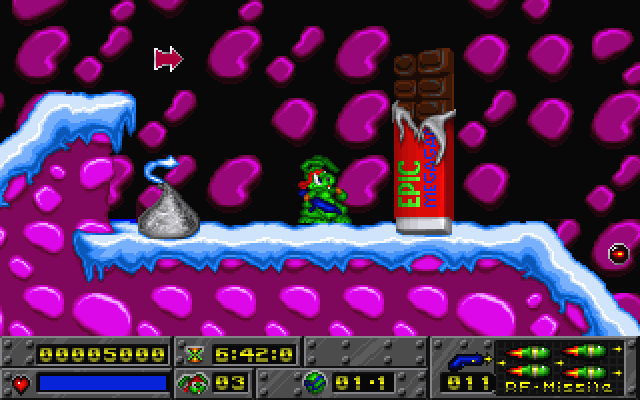
Building a holiday release around an existing engine meant leaning hard on asset redesigns and sound additions. Featuring four levels with new graphics and sound, including a rap version of Little Drummer Boy, the expansion trades standard military posts for surreal holiday landscapes. You shoot your way through environments filled with gingerbread structures, oversized toy blocks, and holiday decorations that contrast sharply with the firepower in your hands.
The sound design is where the presentation truly shines. Alexander Brandon and Robert Allen's tracker music transforms traditional holiday carols into punchy, tracker-driven synth tracks. Hearing a driving hip-hop drum rhythm woven into classic carols while blasting past enemy sprites gives the experience a distinct mid-nineties demoscene energy.
Yet the structure reveals clear compromises made for a quick promotional turnaround. Sadly, there are no bosses in the game, meaning levels end abruptly at signposts rather than culminating in heavy showdowns. Without a multi-stage boss fight at the finish line, the difficulty curve stays flat across all four stages, relying entirely on enemy placement and layout traps to pressure the player.
This Jazz Jackrabbit: Holiday Hare 1995 review must highlight how the missing climaxes change the pacing. In the original campaign, stockpiling heavy launcher ammo for a final encounter gave power-up collection a long-term goal. Here, you are encouraged to expend heavy weaponry liberally on minor enemies like jack-in-the-boxes and mechanical toys because there is no grand encounter waiting at the exit.
Sprinting blind tests your reaction times
Launching a level in this Jazz Jackrabbit: Holiday Hare 1995 MS-DOS game drops you directly into high-speed chaos without warm-up tutorials. The first minute of play involves hitting the floor at a full run, building momentum up ramps, and launching across wide gaps while hammering the fire key. The controls feel slippery on purpose, emphasizing kinetic launch angles over micro-precision platforming.
What hurts the experience today is the limited viewport inherent to 320x200 screen resolution. When running downhill, the camera remains centered on Jazz, leaving almost no visible floor ahead of you. A blind jump frequently ends in a hit from a hidden enemy, forcing you to memorize level layouts through trial and error rather than pure sight.
When studying Jazz Jackrabbit: Holiday Hare 1995 gameplay, the contrast with contemporary console platformers like Sonic the Hedgehog becomes obvious. Where console games used camera-lead tricks to show what lay ahead, MS-DOS platformers often struggled with viewport constraints. The solution in this title was sheer firepower: if you cannot see what is coming, shoot continuously until the path is clear.
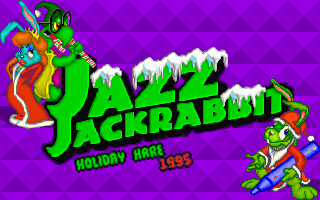
Distribution strategies reflected the peak of shareware culture
This game was freely downloadable on most freeware/shareware sites, making it a powerful marketing engine for Epic MegaGames, Inc. back in 1995. By distributing a standalone, fully playable taste of the engine over bulletin board systems and internet repositories, the publisher kept interest alive for the franchise. Also, there were three new episodes, which were not included in the game unless you order the Jazz Jackrabbit CD-ROM, incentivizing players to upgrade to full physical media.
In terms of execution, the engine represented state-of-the-art PC action software for its moment. Epic MegaGames utilised smooth horizontal scrolling and rapid sprite rotation routines that few PC developers had mastered without specialized console hardware. It proved that MS-DOS computers could handle rapid, arcade-style action without sacrificing visual fidelity or frame rates.
What fails to impress today is the repetition inherent in the stage design. Four levels built around two visual themes (Candion and Bloxonius) run out of fresh ideas quickly. Once you have seen the gingerbread bricks and block formations of the opening minutes, the remaining stages simply rearrange those exact building blocks without introducing new mechanical twists.
Preserving the floppy disk era requires active digital archiving
As a historical artifact, Jazz Jackrabbit: Holiday Hare 1995 remains a fascinating snapshot of how shareware titles built communities. It still holds up as a fast, stylish five-minute distraction that demonstrates the raw speed of early PC platformers. What fails to hold up is the blind level layout design, which relies far too heavily on memory rather than sight. Anyone looking for an evening of mid-nineties PC action should give it a spin, provided they accept the trial-and-error nature of its screen framing.
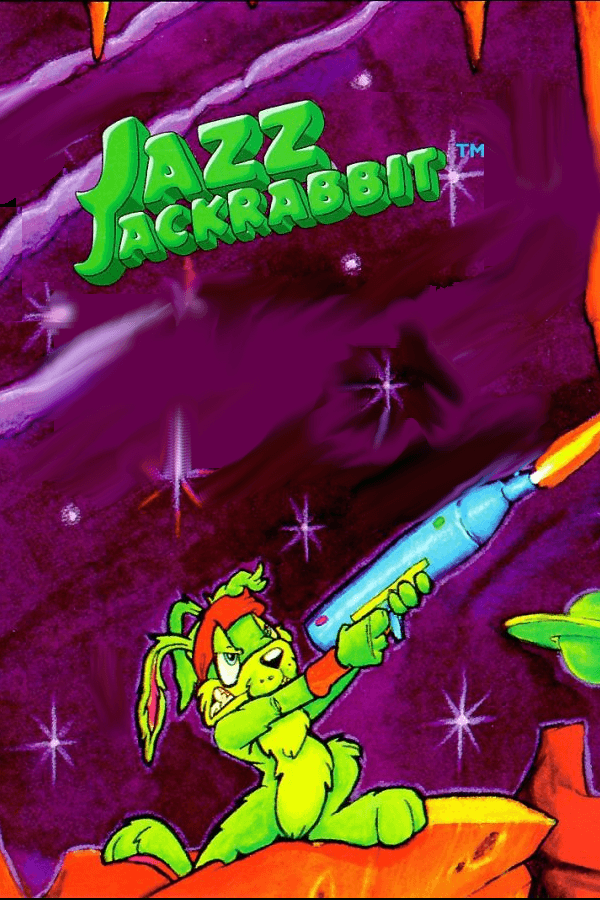
Maintaining a playable copy of this binary today relies heavily on emulation frameworks like DOSBox and careful preservation of original shareware archives. Without dedicated digital archives cataloging the correct metadata, box art, and version histories, minor seasonal releases like this one would easily slip into obscurity. Preserving this title ensures that the energetic early work of developers like Epic MegaGames remains accessible for modern players to test their reflexes against.
How Jazz Jackrabbit: Holiday Hare 1995 is played — the keys the game listens to, grouped by what they do.
- Movement
- Action
- Weapons & items
- Interface
- Other
Highlighted keys are mapped — hover or tap one to see what it does.
Controls are based on the standard Jazz Jackrabbit MS-DOS control scheme.
2 screenshots
From the archive
No gameplay video yet
No gameplay video for Jazz Jackrabbit: Holiday Hare 1995 yet. Sign in to add one.
No reviews yet
Tell the community what you think of Jazz Jackrabbit: Holiday Hare 1995. Reviews are public and tied to your username.
No archived manuals for Jazz Jackrabbit: Holiday Hare 1995 yet
No manuals archived for this title yet. Sign in to upload the first scan.
Cheat codes, console commands and memory pokes for Jazz Jackrabbit: Holiday Hare 1995 — each one verified and attributed.
Sign in to submitNo cheats yet for this title
Know a working cheat, poke or trainer? Add it with the button above. Moderators check every entry before it goes live.
No archived soundtrack for Jazz Jackrabbit: Holiday Hare 1995 yet
No soundtrack archived for this title yet. Sign in to upload the first rip.
No save states for Jazz Jackrabbit: Holiday Hare 1995 yet
No save states for this title yet. Sign in to share one.
Discussions
Sign in to post- Threads0
- Total posts0
- Online now6
Community · Jazz Jackrabbit: Holiday Hare 1995
Who's contributing, and what's new
- Reviews0
- Threads0
- Uploadsapproved0
- Contributors0
Recent activity
Nothing here yet
Reviews, discussion threads and approved uploads appear here as members add them.